
Canada's 2020 National Building Code classifies the country into six climate zones based on the Heating Degree Days index — from Zone 4 (parts of coastal British Columbia) through Zone 8 (northern territories). Minimum R-value requirements for wall and attic assemblies differ substantially across these zones, and choosing insulation material involves more than hitting a number. Moisture management, embodied carbon, fire performance, and installation method all affect long-term building performance.
This article covers the insulation types most commonly specified in Canadian residential construction and renovation, with notes on their performance characteristics in cold-climate assemblies.
Cellulose: The Recycled Fibre Option
Cellulose insulation is produced from post-consumer recycled paper, typically newsprint, treated with borate compounds for fire and pest resistance. It is one of the few insulation materials with a documented negative-to-low embodied carbon profile — the carbon sequestered in the paper base roughly offsets manufacturing energy.
Two installation methods are common in residential work:
- Loose-fill: Blown into attic cavities at a specified density to achieve target R-value. R-3.2 to R-3.8 per inch depending on settled density.
- Dense-pack: Blown into enclosed wall cavities at higher density (approximately 3.5 lb/ft³). At this density, cellulose resists settling and provides modest air-retarding properties.
Dense-pack cellulose performs well in Canadian mixed-humid climates because the material's hygroscopic properties allow it to absorb and re-release moisture without degrading. It does not support mould growth at the borate treatment levels used in commercial products.
A note on vapour management: cellulose does not act as a vapour barrier, so the assembly design must account for the vapour control layer separately. In Climate Zone 6 and above, this typically means a polyethylene sheet on the warm-in-winter side of the insulation.
Mineral Wool: High Density, Non-Combustible
Mineral wool — sold under brand names such as Roxul (now ROCKWOOL) and Thermafibre — is made by melting basalt rock or slag from steel production and spinning it into fibres. The resulting batts and boards are non-combustible, dimensionally stable, and perform at approximately R-4.0 to R-4.2 per inch.
Mineral wool retains its insulating properties when wet — a meaningful distinction in climates where condensation within assemblies is possible. The material does not absorb water (hydrophobic treatment repels bulk moisture), though vapour can still pass through.
For exterior continuous insulation applications — a technique increasingly used to control thermal bridging through studs — rigid mineral wool board is one of the few non-combustible options. This matters for mid-rise buildings subject to fire-rated wall assembly requirements under the National Building Code.
Cork Board Insulation
Expanded cork board is produced by granulating cork oak bark and heat-fusing the granules without adhesive. The manufacturing process uses the suberin content of the cork itself as binder, making it one of the few insulation materials that is both natural and structurally rigid without added chemicals.
Thermal performance sits at approximately R-3.6 per inch — slightly below mineral wool but substantially above many other natural materials. Cork's compressive strength allows it to be used in below-grade applications and under slab assemblies where softer materials would compress under load.

Canadian availability is limited — cork is imported primarily from Portugal and Spain. Costs are significantly higher than domestic mineral wool or cellulose options. Specifiers typically use cork in applications where vapour-open, natural material assemblies are a project requirement rather than a cost-minimization goal.
Spray Polyurethane Foam
Spray polyurethane foam (SPF) is applied as a two-component liquid that expands and cures on contact. It is available in two formulations:
- Open-cell (0.5 lb/ft³): Lower density, R-3.5 to R-3.8 per inch. Vapour-permeable. Not suitable for below-grade or high-moisture applications without additional vapour control.
- Closed-cell (2.0 lb/ft³): Higher density, R-6.0 to R-7.0 per inch. Acts as its own vapour retarder at 2 inches or more. Suitable for below-slab, basement wall, and cathedral ceiling applications.
Closed-cell SPF has the highest R-value per inch of any common insulation material, which matters when assembly thickness is constrained. It also adheres to irregular surfaces and seals air simultaneously, reducing the need for a separate air barrier.
The trade-off is environmental: most closed-cell SPF uses hydrofluorocarbon blowing agents with high global warming potential. Some manufacturers now offer HFO-blown formulations with substantially lower GWP, and these are gradually becoming more available through Canadian distributors.
Blown-In Insulation for Retrofit Applications

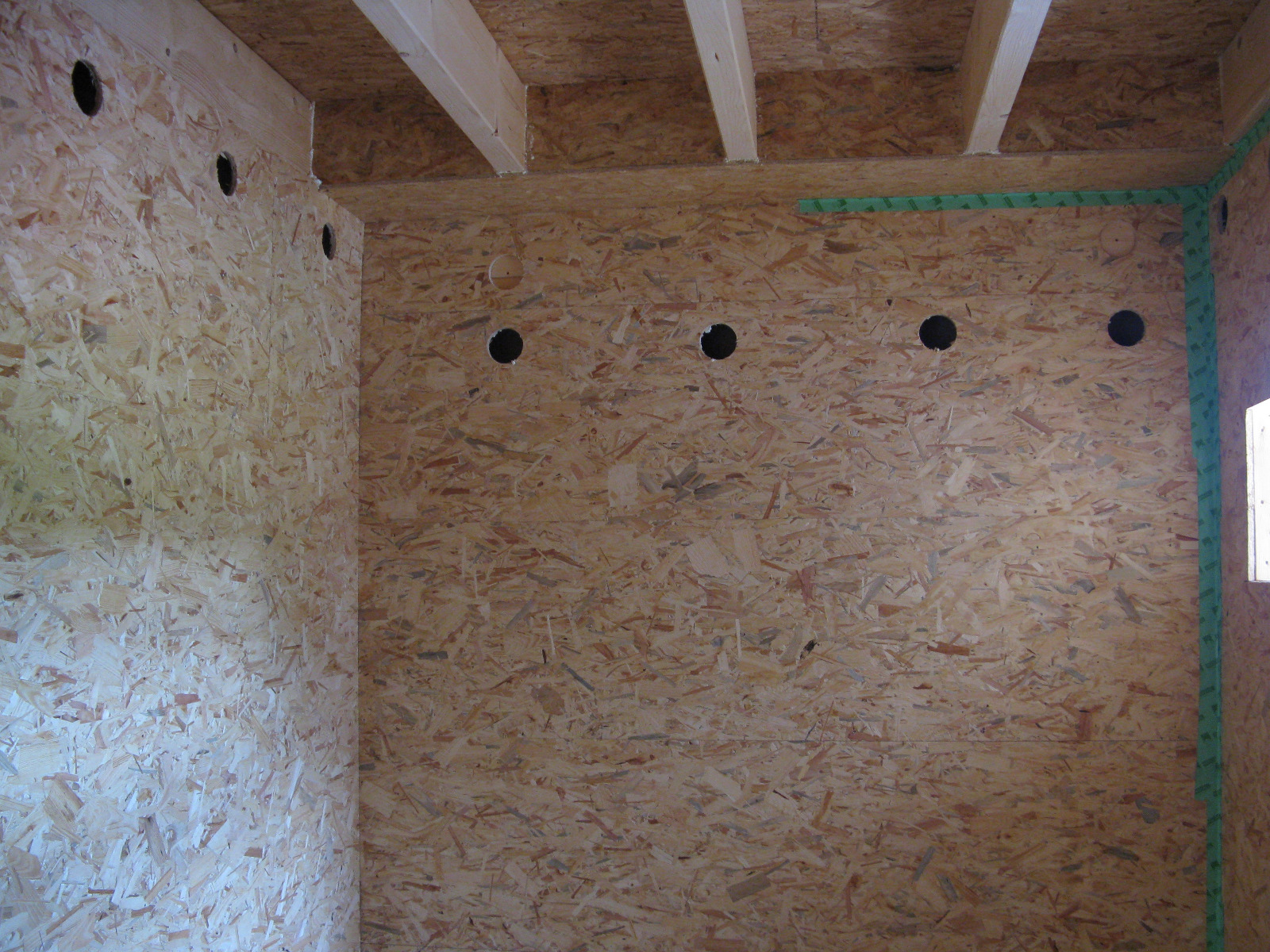
Retrofit insulation — adding insulation to existing walls without full demolition — is one of the most cost-effective energy improvements available to existing Canadian homes. The process typically involves drilling holes in the wall sheathing (from exterior) or drywall (from interior), filling the cavity with dense-pack cellulose or mineral wool, and patching the holes.
The Canada Greener Homes Grant (now succeeded by the Canada Greener Homes Loan) provided funding for this type of work when paired with an EnerGuide assessment. Program terms change; current details are available at Natural Resources Canada.
Comparing Insulation Types: A Summary
At a Glance
- Cellulose — R-3.2 to 3.8/in, recycled content, vapour-open, good retrofit option
- Mineral Wool — R-4.0 to 4.2/in, non-combustible, moisture-resistant, exterior CI boards available
- Cork Board — R-3.6/in, natural, compressive strength, imported, higher cost
- Open-Cell SPF — R-3.5 to 3.8/in, vapour-open, good for cathedral ceilings
- Closed-Cell SPF — R-6.0 to 7.0/in, vapour retarder, highest per-inch performance, higher GWP blowing agents (HFO options available)
Canadian Climate Zone Minimums
The 2020 National Building Code sets minimum RSI values for walls and attics by climate zone. For reference, a few benchmarks:
- Zone 4 (Vancouver area): Walls RSI-3.08 (approx. R-17.5); Attics RSI-8.67 (approx. R-49)
- Zone 6 (most of Ontario, Quebec): Walls RSI-3.87 (approx. R-22); Attics RSI-8.67 (approx. R-49)
- Zone 7 (northern Alberta, northern Manitoba): Walls RSI-4.67 (approx. R-26.5); Attics RSI-10.0 (approx. R-56.8)
These are code minimums — many high-performance programs (Passive House, net-zero ready) specify substantially higher values. The Passive House standard requires attic insulation in the range of R-60 to R-100 depending on climate, combined with highly airtight assemblies.
Vapour Management in Cold Climates
In Canadian cold-climate construction, vapour drives flow predominantly from warm interior air toward the cold exterior in winter. Standard practice in Climate Zones 5–8 requires a Class II or Class I vapour retarder on the warm-in-winter side of the insulation — typically a polyethylene sheet behind the drywall.
Assemblies using exterior continuous insulation change this calculus. Sufficient exterior R-value raises the temperature of the sheathing above the dew point for interior air, reducing the need for a vapour barrier at the stud plane. The Building Science Corporation has published widely-referenced guidance on this approach, applicable to Canadian construction.
For reference: Building Science Corporation — Understanding Vapour Barriers.